
A featured contribution from Leadership Perspectives: a curated forum reserved for leaders nominated by our subscribers and vetted by the Construction Tech Review Advisory Board.

Unite Students
How to Transform IT Leadership from Systems to Strategy
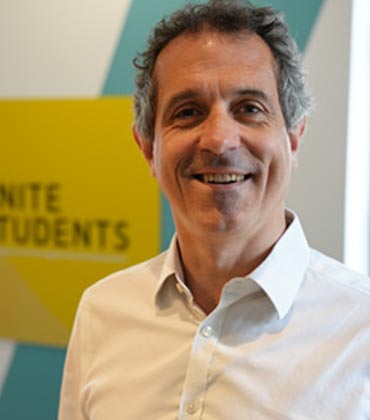
James Maunder is Director for Digital and Information Technologies at Unite Students, the UK’s largest provider of purpose-built student accommodation and an FTSE 100 company. He is a people-anchored leader of business technology teams. He builds organisations, nurtures inclusive cultures rooted in equality and diversity, defines and delivers strategies and solves complex challenges. His technology experience of more than 25 years spans healthcare, publishing, FMCG, membership, retail, hospitality and the commercial, not-for-profit and charitable sectors.
In this article, Maunder provides invaluable insights into the shift from system-centric to business-centric approaches in ERP implementation and the growing importance of AI and business process automation. He also discusses the importance of adaptive leadership in fostering a collaborative and creative work environment.
Reflecting on Past Roles
I describe my career journey in three stages. Initially, I studied geology and biology, eventually finding a passion for business. I began my career at Unilever, where I spent nine years learning the ropes of information management. I worked on data architecture, business intelligence, and global information management from the ground up, gradually gaining team leadership experience.
In the second phase, I spent another nine years at Twinings, the UK's largest speciality tea company, where I headed business systems and change. My responsibilities span from desktop applications to logistics, supply chain, and HR systems, periodically overseeing infrastructure functions.
The third phase of my career saw me move into overall IT leadership roles. I served as the Director of Information Technology at the Institute of Directors, then as IT Director at Oxford University Press for the children's publishing division, and later as CIO at The London Clinic, the UK's largest independent private hospital. My role at The London Clinic, especially during the COVID-19 pandemic, was particularly challenging and humbling, as I led the technology function through unprecedented times.
Now, as the Chief Information Officer at Unite Students, I lead the digital transformation of the UK's largest provider of purpose-built student accommodation, supporting 70,000 students across 160 buildings in 23 cities.
Trends From Systems to Business Needs and Beyond
I've observed a shift away from starting conversations about systems. The IT industry and internal technology teams have often used systems as a proxy for business change. However, starting with the business need rather than the system is becoming increasingly common.
This approach is crucial as we strive to drive value and differentiation for our organisations. We are implementing an ERP system, and whether SAP, Microsoft, or Oracle should not be the primary focus. The starting point must always be what the business needs.
Another trend I see is the rise of artificial intelligence technologies. While the conversation around AI can sometimes be overblown, it's essential to focus on what AI is truly capable of. AI can serve as a golden thread through the systems we use, elevating them by freeing humans from repetitive, easily diagnosable tasks. This allows people to focus on work that requires human intervention, care, empathy, and creativity.
Additionally, there's significant growth in technologies focused on true business process automation. Low-code and no-code platforms, for example, can integrate with ERP systems to provide end-to-end business process automation. These technologies wrap around existing systems, enhancing their capabilities and driving efficiency.
Insights on Navigating Challenges
The complexity can be overwhelming if one starts with the technology. Instead, begin with the business by defining the necessary business capabilities—processes, inputs and outputs. Once you have this mapped out, layer the technology over these capabilities to see what each technology will do for you.
Our approach to understanding business needs first has transformed how we implement technology solutions, leading to significant operational improvements and increased satisfaction.
The choice is a double-edged sword. While it enables, it can also lead to analysis paralysis. Sometimes, good enough is good enough. If you have a tool that works, use it. A company always claims its solution is better but doesn’t let perfection be the enemy of good.
Leadership Philosophy to Empower Teams
Drawing inspiration from Simon Sinek's ‘Leaders Eat Last,’ I view my role as a technology leader as akin to a conductor in an orchestra. An IT leader can't be an expert in everything—cybersecurity experts may lack data architecture knowledge, data architects may not know cloud computing, and cloud experts might not understand financial systems. My job is to create a safe space, bring out the best in everyone and foster a culture where people feel free to be themselves, share their creativity and leverage their lived experiences.
A fantastic boss at United Students emphasised that the world is VUCA—volatile, uncertain, complex and ambiguous. The best way to handle a VUCA world is through creativity. By creating a safe environment for idea-sharing and experimentation, we can work together to overcome the incredible challenges we face.
Advice for Young Professionals
My advice to young professionals is to prioritise personal development and stay ahead of market trends. Building and maintaining networks, attending events, and proactively developing one's skills and knowledge is crucial. At Unite, I often remind my team that we are the technology thought leaders. We can't look internally for answers; they come from outside. This means building, maintaining and growing networks, engaging with others to share information, solve problems and innovate. We must stand up as thought leaders and prioritise our development.

